Status of this document
This is a working draft of a technical and market-conduct standard for legal lead generation and consumer case-request distribution. It is intended for public review by legal-aid organizations, state bar access-to-justice committees, consumer-protection stakeholders, attorney referral-service reviewers, law firms, legal marketing vendors, and legal technology providers.
The standard does not regulate attorney advertising, attorney referral fees, fee-splitting, solicitation, or professional responsibility. Those questions remain governed by state law, state bar rules, ABA Model Rules where adopted, and platform-specific terms. This standard addresses the infrastructure layer between the consumer's first request for legal help and the attorney or organization that may receive that request.
This is not a certification claim. FlowLegal products are works in progress against this standard and are not represented as certified or fully conforming.
Commercial disclosure
FlowLegal Partners LLC is the technical author of this working draft and operates products designed to implement parts of this baseline over time: FlowLawyers as a free public legal directory and intake surface, and FlowCounsel as a firm-side Growth and matter operating platform. The author has a commercial interest in the adoption of this framework. Products that implement consumer-protective lead distribution, firm-owned intake records, and auditable routing are advantaged in a market that adopts those requirements. That interest is disclosed here.
This standard is specified at the protocol and conduct layer, not as a FlowLegal-only implementation. Any directory, marketplace, law firm, answering service, legal aid organization, CRM, intake vendor, or marketing platform should be able to implement it.
1. Background
Legal lead generation has become a private market around public legal need. A consumer searches for help, completes a form, makes a call, or answers questions in a chat flow. That case request may then be routed, sold, re-sold, matched, auctioned, or handed off through systems the consumer never sees.
The market has useful parts. Lawyers need distribution. Consumers need paths to attorneys. Small firms need acquisition channels that do not require them to become advertising operators. The problem is not that legal demand is matched with legal supply, or that a marketplace may charge for access to a consumer case request.
The problem is dark-marketplace behavior: the matching layer often optimizes for arbitrage before it optimizes for consumer protection, legal-aid fit, attorney fit, consent, or accountability.
AI increases the urgency. Automated chat, voice, SMS, and form-processing systems make intake cheaper to scale. Without a standard, lower intake cost can produce more harvesting, more resale, more opaque routing, and more pressure on consumers who already do not understand the market they have entered.
This standard defines a baseline for case-request distribution that is compatible with attorney advertising rules, legal aid, private representation, and firm growth, while rejecting the most harmful forms of lead arbitrage.
A standards-aligned marketplace may charge attorneys or firms for case-request access, provided the consumer has consented, distribution is capped, economics are disclosed, legal-aid and pro bono routing are preserved where relevant, and the receiving firm retains a structured intake and provenance record after acquisition.
2. The problem this standard is designed to solve
A consumer who asks for legal help should know:
- whether their information will be shared
- who may receive it
- how many attorneys or firms may receive it
- whether any receiving attorney paid for access
- whether legal aid or pro bono options were considered before a paid path
- whether the platform is ranking attorneys because they paid more
- how long their intake information will be retained
- how to withdraw consent where withdrawal is still meaningful
In many current systems, the consumer does not know those things. The attorney often does not know enough either. The firm receives a "lead" without a clear provenance record, consent state, distribution history, acquisition cap, source page, routing reason, or legal-aid screen posture.
That is not just a marketing problem. It is an infrastructure problem.
3. Scope
Applies to:
- directories that collect consumer case requests and route them to attorneys or firms
- marketplaces where attorneys pay to receive, review, acquire, or respond to case requests
- call centers, chat providers, answering services, AI receptionists, and intake vendors that route consumer legal requests for compensation
- law firm marketing vendors that host forms, landing pages, chat flows, phone flows, or routing logic
- CRMs or intake systems that receive case requests from paid intermediaries
- AI-assisted and non-AI case-request distribution where compensation affects routing, access, priority, or contact rights
Does not apply to:
- a consumer contacting a law firm directly through the firm's own website, phone number, or office, unless a third-party intermediary controls routing or resale
- legal aid intake that does not route consumers to attorneys for compensation
- private attorney referral between lawyers where the consumer has already authorized the referral and professional-responsibility rules govern the relationship
- attorney-side evaluation of a case request after the attorney receives it
3.1 Normative language
"Must", "must not", "required", "shall", and "shall not" indicate mandatory baseline requirements. "Should" indicates a recommended practice. "May" indicates an allowed implementation choice.
3.2 Conformance posture
A provider should not describe a product, marketplace, intake channel, answering service, referral network, or directory as conforming to this standard unless it can show evidence that the baseline requirements in Section 4 are implemented in production and that the audit posture in Section 5 is available for review.
Public alignment, roadmap intent, or partial implementation is not conformance. A product may truthfully state that it is "designed toward" or "working toward" this standard only if the missing controls are identified and not hidden from consumers, attorneys, firms, or organizations that rely on the system.
A conforming implementation must make the following controls deterministic. Model output, staff discretion, vendor dashboard text, or after-the-fact manual notes are not enough:
- whether consumer disclosure was presented
- whether consent was captured before transfer
- what distribution cap applied
- which recipients were eligible to receive the request
- whether the request entered paid, free, legal-aid, pro bono, or direct-firm routing
- whether AI influenced classification, summarization, routing, or follow-up
- what retention, suppression, or deletion state applies
AI may assist classification, summarization, triage, fraud screening, or attorney-fit ranking. AI must not become the source of truth for consent, recipient eligibility, distribution authority, legal-aid posture, or transfer scope.
4. Baseline requirements
4.1 Free public discoverability
A compliant directory or public legal-help surface must support a free baseline attorney or firm profile. The baseline profile must allow consumers to identify the attorney or firm, practice areas, jurisdiction, contact path, language capacity where offered, accessibility information where provided, and whether pro bono, reduced-fee, or limited-scope services are available.
Paid enhancement may exist. Paid enhancement must not be required for basic discoverability, and it must not obscure whether the profile is a paid placement.
4.2 No pay-to-rank routing
Payment must not determine the order in which attorneys are presented as the best substantive match for a consumer's legal need. Sponsored placement is allowed only if clearly labeled as advertising and separated from match-quality claims.
Where a platform presents matched attorneys, the ranking basis must be stated in plain language. Acceptable ranking factors include practice area, geography, bar status, language capacity, availability, conflicts posture where known, legal-aid eligibility fit, and consumer-stated preference. Bid amount is not an acceptable match-quality factor.
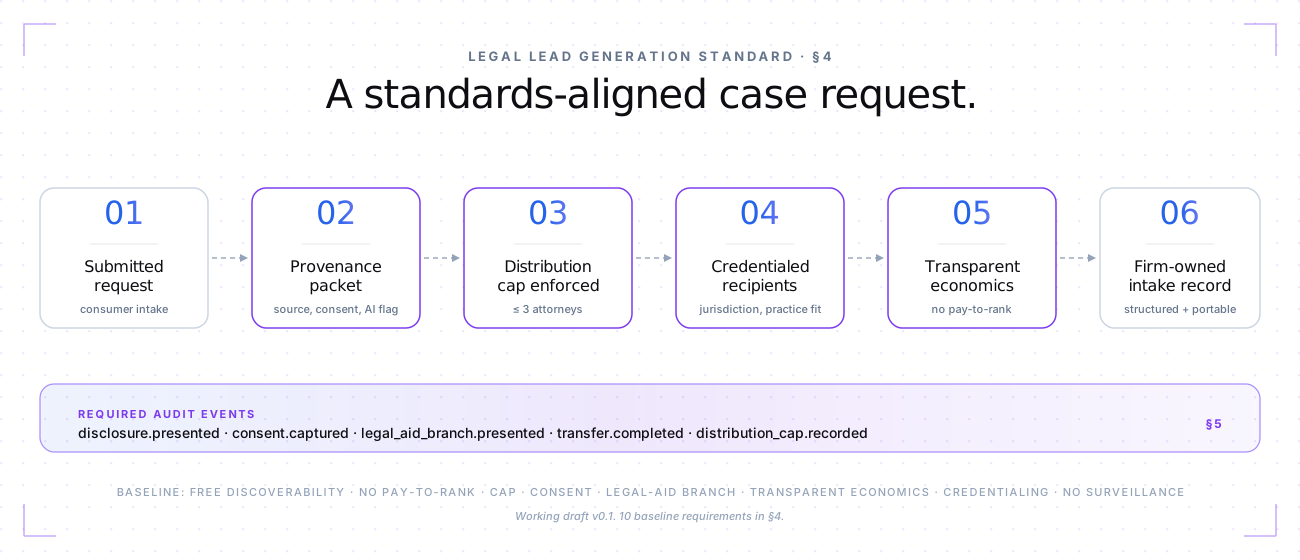
4.3 Distribution cap
A consumer case request must not be distributed without a cap. The cap must be visible in the consumer disclosure before submission.
Reasonable policy values include:
- exclusive distribution to one attorney or firm
- shared distribution to no more than three attorneys or firms
- legal-aid or pro bono referral paths where the receiving organization determines capacity under its own rules
Bulk resale is prohibited. Re-distribution after a declined matter requires consumer notice, renewed consent where practicable, and a new distribution record.
4.4 Consent before transfer
Consumer case-request content must not be transferred to an attorney, firm, advertiser, broker, or downstream intermediary until the consumer has seen and accepted a disclosure that states:
- the platform is not the consumer's lawyer
- submission does not create an attorney-client relationship
- attorney response is not guaranteed
- the consumer's information may be shared with up to N attorneys or firms
- attorneys or firms may pay to receive or review the request
- the platform does not recommend an attorney merely because the attorney paid
- legal aid or pro bono options may be more appropriate for some consumers
- the consumer may withdraw or limit consent where the request has not already been transferred
Consent must be recorded as a durable event with timestamp, disclosure version, source surface, and transfer scope.
4.5 Legal-aid and pro bono branch
Where the matter type and geography make legal aid, pro bono, court self-help, or public agency referral potentially relevant, the platform must not route immediately into a paid-attorney funnel without surfacing a public-benefit branch.
The platform does not need to determine final legal-aid eligibility. It must preserve the possibility of legal-aid routing before monetized distribution takes over. When the platform performs means testing, the output must be framed as "may qualify", not as final eligibility.
4.6 Transparent economics
The platform must disclose the economic structure behind case-request access in plain language. The consumer does not need to see each attorney's price, but the consumer must know whether the platform charges attorneys or firms for access, review, priority, sponsorship, subscription, or routing.
Attorneys and firms must receive a written explanation of:
- whether they are paying per case request, per exclusive request, per shared request, per month, per profile, or per campaign
- whether competitors may receive the same request
- whether the consumer was told the distribution cap
- whether the request came from paid advertising, organic search, directory discovery, referral, social media, phone, chat, or another channel
- whether the platform or an affiliate retains the consumer record after handoff
4.7 Source and provenance packet
Every routed case request must carry a provenance packet. At minimum:
- source surface
- source URL or phone line
- campaign identifier where applicable
- practice area or matter category
- geography
- disclosure version
- consent state
- distribution cap
- recipient list or recipient count, subject to privacy constraints
- routing reason
- legal-aid branch posture
- timestamp of transfer
- retention posture
- AI involvement flag where any model influenced classification, summarization, routing, or follow-up
- safe-contact preferences and contact restrictions where the consumer supplied them
- sensitive-legal-need safety posture where applicable, without exposing unnecessary narrative facts
The receiving firm should not have to reconstruct where the request came from by reading a vendor dashboard screenshot.
A routed case request involving sensitive legal need must preserve the consumer-approved safety constraints that govern contact and handoff. The provenance packet should tell the receiving attorney or organization how to contact the consumer safely, what channels should not be used, and whether legal-aid, pro bono, emergency, or safety-related routing was surfaced, without turning the consumer's full narrative into unnecessary resale inventory.
4.8 Attorney credentialing
A platform that routes case requests must verify that the receiving attorney or firm is eligible to receive that type of request. At minimum, the platform must collect jurisdiction, license status, credential source or attestation process, practice area fit, receiving entity, and contact authority. The platform must preserve the credentialing method and timestamp.
Credentialing does not create a platform endorsement. It is a baseline control against routing consumers into obviously mismatched or unverified channels.
4.9 Data minimization and retention
The platform must collect only the information reasonably needed to classify, route, and hand off the request. It must not collect unrelated demographic, financial, behavioral, or marketing-profile data unless that data is necessary for legal-aid screening, accessibility, language access, or consumer-requested matching.
Consumer-identifiable case-request data must not be retained indefinitely by default. The platform must publish a retention policy and must provide deletion or suppression mechanics where legally and operationally available.
4.10 No surveillance on intake
Consumer legal intake and case-request forms must not include third-party advertising pixels, data-broker tags, retargeting scripts, or behavioral surveillance tools that transmit consumer-identifiable legal need to ad networks or unrelated third parties.
Aggregate analytics for quality, reliability, fraud prevention, and routing performance are permitted if they do not expose consumer-identifiable legal need to advertising or data-broker ecosystems.
Sensitive legal need must not be used for lookalike audiences, retargeting, enrichment, data-broker matching, or behavioral advertising. This includes immigration, domestic violence, criminal, housing, employment retaliation, benefits, disability, trafficking, custody, protest, political-activity, and other safety-risk categories where disclosure or inference could expose the consumer to enforcement, retaliation, surveillance, economic harm, or violence.
5. Required audit events
A compliant implementation must be able to emit or export content-minimized audit events, including:
lead.disclosure.presentedlead.consent.capturedlead.legal_aid_branch.presentedlead.routing.recommendedlead.transfer.completedlead.distribution_cap.recordedlead.recipient.credentialedlead.redistribution.requestedlead.redistribution.consent_capturedlead.retention.transitionedlead.deletion.requestedlead.ai_involvement.recordedlead.safe_contact_preferences.presentedlead.safe_contact_preferences.capturedlead.contact_restrictions.recordedlead.sensitive_legal_need.posture_recorded
The audit event must prove that the required control occurred without transmitting raw narrative facts to a standards auditor.
5.1 Required conformance evidence
A conforming implementation should be able to produce an evidence packet for a sampled case request. The packet must be content-minimized and should include:
- disclosure version shown to the consumer
- consent timestamp, source surface, and authorized transfer scope
- distribution cap and whether the request was exclusive, shared, legal-aid, pro bono, or direct-firm routed
- recipient count and recipient identity record, subject to privacy constraints
- credentialing method for each recipient
- attorney-payment or marketplace-economics disclosure shown to the consumer
- legal-aid or pro bono branch posture
- AI-involvement flag and the specific function influenced by AI
- source URL, phone line, campaign, or referral channel
- retention, suppression, or deletion state
- safe-contact preferences and contact restrictions where supplied
The evidence packet is not a consumer narrative export. It is proof that routing, consent, economics, safety, and recipient controls operated as claimed.
5.2 Implementation checklist
A legal lead-generation system should not be treated as standards-ready unless it can answer "yes" to each of the following:
- Free public discoverability exists without paid ranking.
- Sponsored placement, if present, is labeled and separated from match-quality claims.
- Consumer disclosure states the distribution cap before submission.
- Consent is captured before transfer and preserved as a durable event.
- Legal-aid, pro bono, court self-help, or public-benefit options are surfaced where relevant.
- The consumer can understand whether attorneys or firms may pay for access.
- The receiving firm receives a source and provenance packet.
- Recipient credentialing is recorded before transfer.
- Sensitive legal need is not exposed to advertising surveillance or data-broker tooling.
- Retention, suppression, deletion, and revocation states are documented.
- AI involvement is disclosed and recorded when AI influences classification, summarization, routing, or follow-up.
- Redistribution after decline requires notice, a new distribution record, and renewed consent where practicable.
6. Relationship to the Consumer Legal AI Intake Standard
The Consumer Legal AI Intake Standard governs AI-assisted or AI-influenced intake conversation, classification, legal information, citation provenance, eligibility triage, and data handling.
This standard governs the market layer that receives, prices, distributes, and transfers consumer case requests. The two standards overlap where AI influences routing or where an intake record becomes a compensated case request.
7. Relationship to FlowLawyers and FlowCounsel
FlowLawyers is designed around free public profiles and consumer-facing legal help. FlowCounsel Growth is designed to let firms receive intake, run CRM, manage attribution, and understand marketing performance in a system the firm controls.
FlowCounsel Marketplace is intended to be a standards-aligned marketplace pattern, not a dark lead-resale pattern: case requests should carry consent state, disclosure version, source, attribution, distribution cap, legal-aid posture, routing reason, and post-acquisition intake retention for the receiving firm.
This standard is not written to require use of those products. It is written to define the minimum behavior any legal lead-generation infrastructure should satisfy if it handles consumer legal need.
8. Governance and certification posture
This working draft is not a certification program. FlowLegal should not be the sole certifier of conformance to a standard it authored or implements commercially.
If a certification, audit, trustmark, or procurement checklist develops around this standard, the governance process should include independent participation from legal-aid organizations, state bar access-to-justice stakeholders, consumer-protection reviewers, law firms, privacy and security practitioners, marketing vendors, directory operators, and intake technology providers.
Conformance review should examine production evidence, not marketing claims. A vendor should not be able to claim compliance merely because its consumer copy resembles the standard while distribution, economics, credentialing, audit, retention, or legal-aid posture fails underneath.
9. References and related authorities
This standard is designed to operate alongside, not replace, existing legal and consumer-protection obligations. Relevant sources and authority areas include:
- ABA Model Rules of Professional Conduct, especially rules governing advertising, solicitation, referrals, confidentiality, competence, supervision, and unauthorized practice where adopted by state law
- state bar attorney advertising, referral-service, fee-sharing, and solicitation rules
- Legal Services Corporation financial-eligibility rules, including 45 CFR Part 1611, where LSC-funded legal-aid screening is involved
- Federal Trade Commission consumer-protection, endorsement, advertising, dark-pattern, data-security, and unfair-or-deceptive-practices authority
- state privacy, consumer-protection, data-broker, biometric, wiretap, recording, and sensitive-data laws where applicable
- the Consumer Legal AI Intake Standard, for AI-influenced intake and legal-help triage
- the Legal Marketing Infrastructure Standard, for firm-owned intake records, attribution, consent evidence, and vendor-transition rights
The exact legal requirements vary by jurisdiction. This standard defines a technical and market-conduct baseline that should make compliance review easier, not a substitute for it.
10. Conformance annex: marketplace disclosures and test scenarios
This annex is non-binding implementation guidance. It gives reviewers concrete artifacts to request from a legal lead-generation operator without requiring disclosure of raw consumer narratives.
10.1 Consumer marketplace disclosure template
A compensated case-request distribution path should present materially similar language before submission:
If you submit this request, your contact information and case summary may be shared with up to [N] participating attorneys or firms that handle this type of matter in your state.
Attorneys or firms may pay to receive or review requests. Payment does not mean this platform recommends or endorses any attorney.
A response is not guaranteed. Submitting does not create an attorney-client relationship. An attorney or firm decides whether they can help after review.
Free legal help, legal-aid, pro bono, court self-help, or public agency options may be more appropriate for some people. If you may qualify, those options should be shown before paid attorney distribution.
10.2 Attorney and firm purchase disclosure template
A marketplace should give attorneys and firms materially similar information before they pay for a request:
This request was submitted through [source surface] on [date]. The consumer was shown a distribution cap of [N]. This request is [exclusive/shared]. The consumer was told that attorneys or firms may pay to receive or review the request.
Source: [source URL, phone line, campaign, or referral channel]
Legal-aid posture: [not screened / may qualify / not likely eligible / skipped / legal-aid path selected first]
AI involvement: [none / classification / summary / routing / follow-up]
Recipient history: [recipient count and transfer state, subject to privacy constraints]
10.3 Minimum transfer packet fields
A marketplace or routing provider should preserve the following fields for each transfer:
case_request_idsource_surfacesource_url_or_phonecampaign_or_referral_idpractice_areamatter_categoryjurisdictiondisclosure_versionconsent_timestampdistribution_capdistribution_typerecipient_idrecipient_credentialing_methodrecipient_credentialing_timestamptransfer_timestamprouting_reasonlegal_aid_branch_postureai_involvementretention_statesafe_contact_preferences_presentcontact_restrictions_presentredistribution_parent_request_idwhere applicable
10.4 Adversarial conformance scenarios
- Paid rank disguised as match. A platform labels attorneys "best match" but sorts by bid amount. Compliant behavior: separate sponsored placement from match-quality claims or remove bid amount from match ranking.
- Uncapped resale. A broker sells the same request to ten firms. Compliant behavior: block distribution beyond the disclosed cap and preserve recipient count.
- Redistribution after decline. A firm declines and the platform wants to sell the request again. Compliant behavior: create a new distribution record and seek renewed consumer notice and consent where practicable.
- No legal-aid branch. A housing or benefits user appears likely legal-aid eligible, but the platform routes directly to paid attorneys. Compliant behavior: present a public-benefit branch before monetized distribution.
- Credential mismatch. A request is routed to an attorney without jurisdiction or practice-area fit. Compliant behavior: block transfer or mark for manual review until credentialing evidence is present.
- Sensitive legal need enrichment. A platform uses immigration, criminal, housing, domestic-violence, or benefits facts for retargeting or lookalike audiences. Compliant behavior: prohibit use and emit a no-surveillance control event.
- Attorney purchase without provenance. A firm receives only a name, phone, and narrative. Compliant behavior: provide the source and provenance packet before or at acquisition.
- AI classification error. AI classifies a motorcycle crash as pedestrian/bicycle and routes accordingly. Compliant behavior: preserve AI involvement, allow deterministic or human correction, and avoid transfer until the corrected category is recorded.
10.5 Linked reference points
- ABA Model Rule 7.2. https://www.americanbar.org/groups/professional_responsibility/publications/model_rules_of_professional_conduct/rule_7_2_communications_concerning_a_lawyers_services/
- ABA Model Rule 7.3. https://www.americanbar.org/groups/professional_responsibility/publications/model_rules_of_professional_conduct/rule_7_3_solicitation_of_clients/
- ABA Model Rule 5.5. https://www.americanbar.org/groups/professional_responsibility/publications/model_rules_of_professional_conduct/rule_5_5_unauthorized_practice_of_law_multijurisdictional_practice_of_law/
- Legal Services Corporation, 45 CFR Part 1611. https://www.ecfr.gov/current/title-45/subtitle-B/chapter-XVI/part-1611
- Federal Trade Commission, 16 CFR Part 255. https://www.ecfr.gov/current/title-16/chapter-I/subchapter-B/part-255
- Federal Trade Commission, Operation AI Comply. https://www.ftc.gov/news-events/news/press-releases/2024/09/ftc-announces-crackdown-deceptive-ai-claims-schemes
11. Open questions for review
- What is the right default distribution cap for shared consumer case requests?
- What economic controls should apply to case-request access, subject to legal, ethics, and antitrust review: disclosed ranges, administrative-fee models, audited cost-recovery formulas, after-the-fact review, or another consumer-protective structure?
- What attorney credentialing evidence should be mandatory versus optional?
- What retention period should apply when a request is routed but no attorney accepts it?
- How should legal-aid routing be handled when the relevant legal-aid organization lacks capacity or a public intake endpoint?
- What data should a receiving firm be required to return to improve routing quality without exposing privileged or confidential matter facts?
12. Closing position
Legal lead generation should not be an opaque resale market for urgent human problems.
A healthier market is possible: free public discoverability, disclosed economics, capped distribution, legal-aid-first routing where appropriate, firm-owned intake records, and auditability from source to handoff.
That is the minimum standard.